What Penguins Teach Us about Collaborative Fiction and Solarpunk
Can a community write a novel? In 2007 Penguin Books tried to do it: They set up a wiki and let strangers on the internet collaborate on a novel called “A Million Penguins”. Their troubles may help us create a solarpunk classic.
Penguins Ablaze
Some say the project was doomed from the start. How could a community write a novel? Who would be the author? However, it was tried nonetheless. At the time, Wikipedia had been established as a well-known reference and the number of articles was growing rapidly. This may lead to the idea that not only facts could be compiled into something booklike (an encyclopedia), but also stories; the idea of a wiki-novel. An article in The Observer advertises this project and argues, that everybody has a novel in them, so why not come together and write one? As part of a study, students of De Montfort University helped Kate Pullinger, Jeremy Ettinghausen, Bruce Mason and Sue Thomas conduct this experimental form of writing. Naturally, moderation was a major issue, as Pullinger and others say themselves:
We were able to block the truly offensive contributions - porn vandals for the most part, replacing perfectly good nouns with genitally precise nouns. 1
At the same time, they say it was “fascinating to see how a feeling of solidarity grows between people who have never met” and that it was a chaotic fight between creativity and destruction. The best summary might be written by one of the online strangers who contributed to the wiki-novel. They said: “Seriously. This is going to fail horribly. It’s still fun.”2
For me, the interesting part is the automatic pessimism people experience when hearing about this project. James Pressly writing for Bloomberg, for example, said it was “predictably horrible” and concluded that “there’s no real editor, just hordes of kibitzers.”3 However, his review was posted only one day after the project had started. At such a stage, it would be impossible to predict how the experiment would turn out, given the amount of contributions and edits done to the wiki. Pressly himself gives accounts of the website being slow due to the number of visitors. Maybe his pessimism could have been excused if all of this had happened a little later at the beginning of the 2008 financial crisis. But apparently, people don’t need a crisis for the glass to be half empty.
In particular for penguins, the climate crisis might be a good reason to be depressed. Or the 2026 wildfires spreading through western Europe and North America. The tone of the current political and ecological situation does not fit the whimsical title “A Million Penguins”. Interestingly, negative media seems popular in a world which is on fire, which might be the reason Pressly wrote a negative review rather than waiting and hoping for a better outcome. Even within literature and escapist media the genre of grimdark is popular. Warhammer 40k for example plays in a world of infinite and extreme war, without any real progress. The books and games of 40k are written by multiple authors and the community has an important role. Fans made their own films and art, contributing to the story in a more structured way than a wiki-novel. It’s action and fun, but at the same time the thought of such a religious and pointless conquest is just depressing. It’s an interesting contradiction: We feel doomed but enjoy murder mystery shows, play Cyberpunk 2077 and doomscroll through TikTok. We see no future and get attracted to infinite scroll which has no end and thus no future, in a sense.
How to move forward? In his blog, David Blandy writes:
And then there’s the dark of grimdark, a dingy, grimy world of Warhammer 40k or Mork Borg, of the World War One trenches. A vision of a world with no future except doom, just one hellish eternal present. I love these games, and these worlds, but I wanted to propose an alternative. That we can have hope […]
The Solar Hope
The history of photovoltaics can inspire a powerful hope. Take my home country for example: In 2007, electricity from solar modules on a German rooftop had costs on the order of €0.40 per kWh4, which is about double the amount a household would pay to get the energy from the grid5. If it were not for major subsidies by the German state, this technology would not have been profitable. Worldwide adoption would be hard, as not every state has the financial flexibility and political support to subsidize renewable energy sources. Of course wind and hydro were a thing, but frankly: This situation looks dire. How could humanity manage to switch to renewable energy sources if they are not only fluctuating with wind and sun but also expensive? Without political support, it would take a high toll for those who have the money and ethical urge to do so. Most people would not pay double the price for electricity that is only available during the day. You’d have to be an environmental punk to do so, fighting against the established energy sector. In April 2008 amid the ongoing 2008 financial crisis, a person naming themselves John-Robert proposed a new genre in this blog post: Solarpunk.
The name was inspired by steampunk and should emphasize the counter-culture aspects of rejecting conventional energy sources and imagining a world using wind and photovoltaics. Right from the start, solarpunk was political, as their call to action demonstrates:
I personally find it extremely unlikely that a transition to renewable energy can be accomplished without some serious political fights […]. The current political efforts to subsidize the production of ethanol as an alternative to fossil fuels is only the latest example of corruption that needs to be stopped.
It also contained literature, as John-Robert proposed Songs From the Stars by Norman Spinrad to be solarpunk. Furthermore, solarpunk started with visuals. Their post features an image of a cargo ship transporting parts of a wind turbine. To save fuel, it uses a towing kite, making it partially driven by wind.

Solarpark Altötting/Oberkastl by Windwärts Energie is licensed CC-BY-NC-ND.
From 2009 to 2011 the costs for rooftop photovoltaic installations drop significantly5. At the same time, dystopian novels get popular with Suzanne Collins publishing The Hunger Games in 2008 and Catching Fire in 2009, as well as The Maze Runner by James Dashner (2009) and Divergent by Veronica Roth (2011). Stories which take place in a world so broken that straight-up revolution is necessary to save it. But solarpunk is not out of the game. In a forum entry from 2011 people discuss the idea of solarpunk again. This time, the basis is cyberpunk and they bounce world building ideas around, thinking about cool tech while being pessimistic about solar power itself. MormanMobster for example writes:
Obviously, there needs to be a reason why solar technology is used so cheaply and so frequently. Perhaps oil/coal/etc has run out/is only the resource of the very, very rich […]?
Someone else writes that “the major problem with solar right now is that it is extremely inefficient”. Then someone who claims to work in the solar industry mentions that “solar has hit the point where it’s actually pretty damned competitive with conventional energy”. This comment is mostly ignored although it is arguably right: In 2011 the cost for solar energy drops under €0.25/kWh which is competitive with German fossil fuel prices5. The hope radiating from cheap energy is only a spark for now, but it begun to glow. Social justice issues and environmental problems are discussed next to each other and people are envisioning how a world powered by wind, solar and hydro would look. They did not notice that change is happening right in front of them.
In 2014 it is evident that solar power works and has the potential to be significantly cheaper than fossil energy sources. From now on, installations will grow more or less exponentially. As more solar modules are produced, the production costs shrink while efficiency continues to improve. The total power production is still low, but the potential is evident. Hope emerges. The reduced solar prices do not solve many other environmental and social issues and also storing the solar peak for the nighttime energy is not solved. Oil is still the basis for automotive mobility and the oceans are being polluted with plastics, but now the word solar stands for a kind of hope that we can together solve these problems through appropriate use of technology. With this, Notes toward a manifesto by Adam Flynn appears. His most concise formulation might be this:
We’re solarpunks because the only other options are denial or despair.
This emphasis on the necessity of solarpunk is striking: We can either ignore that the future looks dire, panic about it, or do something, which would be the only sensible option. But how?
The Project Hieroglyph argues that we suffer from stagnating innovation6 and that we need “recognizable symbols” that “supply a coherent picture” of technological innovation being integrated in our society. Inventing rocket propulsion is not enough, we would need a vision how to use the technology, like aspiring to reach the stars. Such a vision can be painted by science fiction and motivate real steps for change and innovation, which is something that cyberpunk and grimdark cannot do. Positive change needs positive stories like solarpunk.
While Flynn writes about ingenuity and generativity, artists on Tumblr are discussing visual ideas and inspirations from Art Nouveau, technology combined with food gardens. The talk is about electric cars, airships, greenhouses. But also community, social justice, green cities and education. In 2008 it was a blog, in 2011 a forum and now with the rise of social media, likes, retweets and Tumblr reblogs spread the word about solarpunk. Some examples can be found in the Solarpunk Reference Guide.
An important attempt to solidify the genre was made 2019 with A Solarpunk Manifesto collecting the ideas that floated around during the unstoppable upsurge of solar technology and defining the feel and goals of solarpunk. The manifesto focuses on social justice, diversity and inclusion as much as it focuses on the hope and environmental themes that are usually associated with “solar”.
- Solarpunk envisions a built environment creatively adapted for solar gain, amongst other things, using different technologies. The objective is to promote self sufficiency and living within natural limits.
- In Solarpunk we’ve pulled back just in time to stop the slow destruction of our planet. We’ve learned to use science wisely, for the betterment of our life conditions as part of our planet. We’re no longer overlords. We’re caretakers. We’re gardeners.
A bit like cyberpunk, high-tech solutions are endorsed, however only within the limit of sustainability leading to “High-tech backends with simple, elegant outputs” as the manifesto puts it. It is distinctly different from Climate Fiction as solarpunk focuses on the positive, the endorsement of renewable solutions and searches for practical ways to implement them. Climate Fiction on the other hand, often has an apocalyptic or even dystopian tone (e.g. Parable of the Sower by Octavia E. Butler) and explores the negative consequences of environmental exploitation7. Solarpunk sees itself not only as a genre but also as movement, hence the “Manifesto”. But in particular, it “is a creative re-adaptation of ideas about solarpunk written by many people”. In other words, the solarpunk manifesto is a product of community, made collaboratively.
The manifesto, much like a lot of solarpunk art, is shared under a Creative Commons license. The visual style has partially evolved since John-Robert posted his proposition in 2008 with a header image featuring a cargo ship with sky sails. Airborne wind turbines as in the picture below are omnipresent. As community is considered central to solarpunk, people are shown in the pictures interacting with the envisioned future.
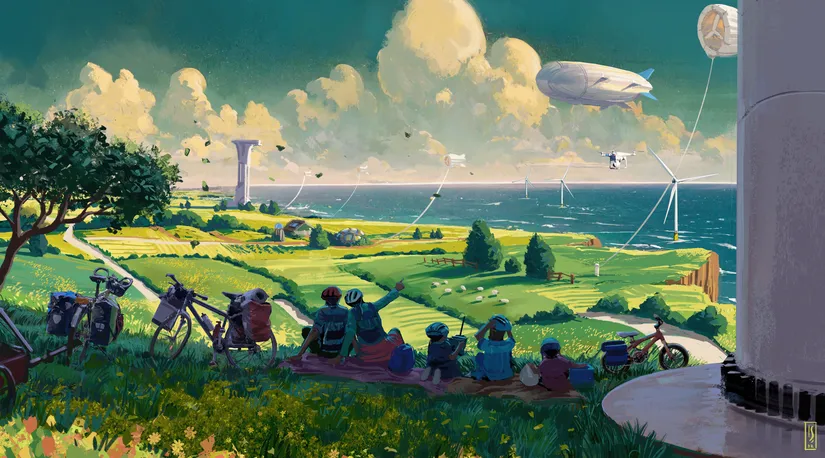
Postcard from a brighter future by Karl Schulschenk is licensed CC BY-NC-ND 4.0.
A Solarpunk digital art piece integrating people and tech alike into nature: Bikers sitting in the shade of a wind turbine.
While some art is about the hopeful feeling, others try to think about possible technology, integration into existing city structure and how to transform our current surroundings into a solarpunk future. In a way, the process to build the future is part of solarpunk, not just the utopia-like outcome. Dustin Jacobus and Eric Hunting take a typical cityscape and transform it within multiple illustrations into their vision of what the city could become. Similarly the art piece below reimagines a real street in Nürnberg.
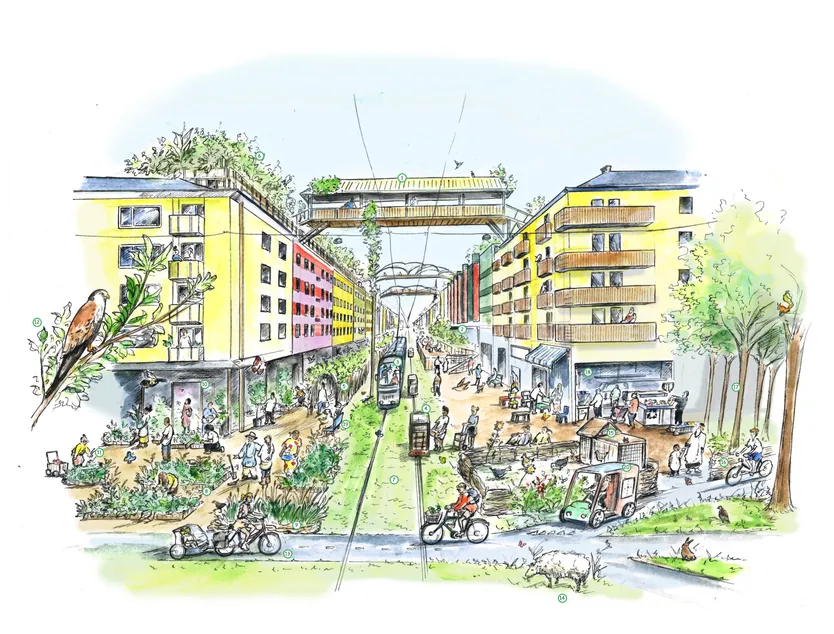
Green street in Nürnberg (Germany) by Dustin Jacobus is licensed CC BY 4.0.
Vision of a transformed street in Nürnberg.
The earliest works of fiction that are considered solarpunk are attributed in retrospect to the genre and are mostly sci-fi with ecological themes that match the feel of the genre. These proto-solarpunk stories include The Fifth Sacred Thing by Starhawk78 and Always Coming Home by Ursula K. LeGuin. Edward Guimont argues that even Asimov’s Foundation has solarpunk traits9. One of the earliest solarpunk works might be an anthology from Brazil called “Solarpunk” that was published in 201310 (it has been translated to English in 201811). Newer works are New York 2140 by Kim Stanley Robinson12 and Sunny and the Mysteries of Osisi by Nnedi Okorafor137. For some, A psalm for the wild-built by Becky Chambers is an exemplary work of solarpunk14, even though the sentient robots fall out of place and much of the book consists of a dialog about purpose, care and empathy as Charles Harries writes in this review. The world of Becky Chambers might be considered solarpunk, but the story is not about environmental change as a central disruption, rather about AI in a way. But who says that solarpunk cannot talk about AI?
As the exact definition of the genre does vary, so does what people consider to be typical for the genre. However, I am not aware of any book that captures the essence of solarpunk in a way that it could be considered a solarpunk classic. Certainly, no book has aged long enough to withstand the hype cycle and be academically recognized as genre-defining the way Lord of the Rings has kick-started fantasy. This might be a stark requirement for a rather new genre, nonetheless it might be necessary. A representative, well-known work makes the genre easier to grasp than a collection of anthologies with story lines that might be powerful but do not linger, or than stories that on their own have no time to leverage their strength into the life-changing, hope-evoking and actionable vision that solarpunk tries to be. While solarpunk has many ideas, key to making these ideas the future is taking action, which is much easier if there is a limited number of world-building ideas implemented. What solarpunks need is a single story connecting everything to make it memorable.
Writing the Solarpunk Classic
The difficulty of writing such a book is obvious: Who would have the authority to decide which of the many cool concepts would make it into the book and which don’t? The easy answer is, that the community decides, either by choosing the classic based on how well the already finished book matches the spirit of solarpunk, or by writing the book itself as a community. The latter option reminds one of the penguin situation from 2007 which taught us that writing as a large group is not trivial. However, a single author is not really an option either: Solarpunk is punk, which means against established authorities. Solarpunk is grassroots action and thus inherently decentralized, without power monopolies. Moreover, solarpunks value diversity and whoever the author might be, a single person can never be diverse; diversity is a property arising from plurality. Even an author from a minority in the Global South would not be diverse, as the number of perspectives not present in the work would outnumber the real-life experiences of any such person. I still think it is possible that a single person manages to represent perspectives from all over the world, but it would need interviews, travel, research and in general a lot of work. It would be so much easier to split the work up and work as a group, a community. However, creating and resolving conflict, as well as understanding storytelling and plot structure depend on expertise in fiction writing; a kind of expertise that is not ubiquitous. Therefore the number of people who can edit a story is very limited compared to the number of people who could correct a misleading statement on a Wikipedia page, where the factual content of the writing is more important than writing style and coherent voice. Letting everybody edit would mean lowering quality, losing focus and creating the kind of chaos A Million Penguins became. Effective and efficient processes for reviewing edits and assuring quality are required.
The choice of tools to do so is non-obvious. Software like MediaWiki has the ability to moderate and revert changes. Furthermore Wikipedia as a project shares traits with solarpunk as it has an inherent anarchist core: In principle everyone can edit. There is no classical editor and publisher; just the crowd which is more likely to correct mistakes than create errors, as there is no incentive for destruction if it can be restored with a single click.
However, wikis are not a tool to write linear text. Wikis are for linking concepts, for non-fiction text that is structured and editable without global context. This is a major flaw of A Million Penguins: Chapters of a novel are embedded within a framework that is large, within a main story that gives meaning to the chapter. A good story requires that the themes and story beats are consistent. There is just no way that one could contribute without at least having read the whole text, the character sheets and plot outline.
Edits need to be reviewed in context, a task that can be better done with tools created for software development. Changes could be tracked and merged into the main text using version control software like git. The advantage of established group programming practices over wiki conventions is that requests for including contributions have a more elaborate workflow: changes generally are requested and discussed in issue tickets before implementation. Prior to merging the changes into the main body of work, everything gets reviewed line by line, before being approved. Such a workflow would give a smaller group of people a lot of power as someone needs to decide which changes are rejected. This looks a lot like the traditional way: One main author (or a small group of authors), inviting selected people to edit.
This would mean writing the book like it is common practice in the industry, while losing plurality and excluding the rich solarpunk community from the creation process. This is in direct conflict with the spirit of solarpunk. Phoebe Wagner questions established processes around writing in her craft essay from 2025:
When I talk about solarpunk, I always ask: How can we tell the story of the climate crisis, environmental justice, or social justice with the craft tools we are taught to use because those same tools created the narratives of toxic individualism, consumption, and capitalism that landed us here in the first place.
In order to change the future we need hope. Hope which can be inspired by stories which envision a good future and talk about steps towards it. However, we cannot expect that the writing and publishing process that gave us cyberpunk and dystopia will return something as hopeful, actionable and nonetheless entertaining as we want our solarpunk to be.
A Proposal: Local & Actionable Fiction
Sadly, much of the solarpunk movement seems to be talk with little action. Getting inspired by the cool name solarpunk and endorsing the goals of the movement are one thing, but taking politically relevant action is more difficult. To my shame, this post doesn’t announce anything concrete that I would start. However, I would like to share my vision for a solarpunk classic that (in my opinion) would be ideally solarpunk while still having the potential to be disruptive, helpful and entertaining.
Suppose you walk through your local park and spot a public bookcase. You decide to browse and see a book with the name of your city on it. Upon inspection you notice that it was bound by hand. You take it home to read.
The story features places you know and problems you know. You empathize with the protagonist, because of your similar experiences within the city. However, this fictional person lives in a much nicer version of your city, where the small shops didn’t die out, where kids cycle to school safely, the park was brought back to life and jobs do something meaningful. Even if you do not care about the environmental aspect of solarpunk, you begin to realize how much nicer your city could be and how much power the civic community has over the place we live in. You understand that modern technology gives us the tools to shape our future for the better without the need to destroy our environment, if we wield this power wisely.
The acknowledgment at the end of the book states that the authors come from your city. They were coached by experts who did similar projects with other cities, but the vision came from people like you. There is a link to the digital edition and a tutorial on how to print and bind a copy of the book yourself, as the authors published everything under a Creative Commons license. The only thing they ask is, that you return your copy to a public bookcase, so that others may read it too.
Local fiction has the potential to capture people and get them to think in actionable ways. It may be spread in existing communities and can make it to the local news. Due to its authenticity and place-bound content, people who would otherwise not read solarpunk may be attracted. These books can easily be associated with existing movements in the city and integrate into an existing community.
A local community might be what was missing from A Million Penguins, as the final research report suggests.
There was no community built around “A Million Penguins” because it was not a setting in which community could form. A “crowd” certainly gathered around it and some users seem to have created small, ad-hoc groups of interest in bits of the wiki novel but there was no over-arching sense of communal construction15.
Writing a book takes a common goal, a shared vision and an understanding of one’s position in the group. While online communities are certainly capable of such things, the web is a large place with so many possible ideas, that it is overwhelming and cannot possibly be implemented in a single story. Limiting authors to a local community can reduce the number of ideas and thus provide focus. Admittedly, this does reduce the plurality and possible diversity a bit. However, I believe that a community healthy enough to come up with a good solarpunk book must already be sensitive to this matter.
Of course there will be similarities between such works from different places. Similar problems exist all over the world, although in differing variations. I imagine reading them one at a time while they inspire each other. This could be compared to an oral tradition passed over different generations. Like a fairy tale, we might end up with a definitive version people will remember in a hundred years. The meta-story that started it all, with all the ideas that turned out to be good and those that didn’t.
The Bottom Line
The most repeated writing advice is quite plain: Just write. Don’t let this idea of collaborative fiction stop you from writing alone. Writing takes practice just like playing a musical instrument. And people playing in an orchestra practice mostly alone until they come together and create something bigger than the sum of its parts.
I don’t know how this discussion needs to be continued. Did I miss an important point? Do such projects exist and I did not find them? Do you want to start something yourself? Feel free to tell me. All I know is, that we need hope and solarpunk can give us hope for our environmental future. And I know what Erich Kästner once wrote: “Nothing good happens. Unless: you do it.”16
-
K. Pullinger, C. Wilks, T. LeBusque, J. Howard, C. Meade, A. Norrington, K. McGill, S. Thomas. “Living with A Million Penguins: inside the wiki-novel”. The Guardian. Mar. 12, 2007. Available: https://www.theguardian.com/books/booksblog/2007/mar/12/livingwithamillionpenguins ↩︎
-
B. Mason, S. Thomas. “A Million Penguins Research Report”. Institute of Creative Technologies De Montfort University, Apr. 24, 2008. p. 21. Available: https://www.ioct.dmu.ac.uk/documents/amillionpenguinsreport.pdf ↩︎
-
J. Pressly. “In Wikinovel, Big Tony Craves Pizza, Carlo Shoots Up (Update1)”. Bloomberg. Feb. 2, 2007. Available: https://web.archive.org/web/20121016063542/http://www.bloomberg.com/apps/news?pid=newsarchive&refer=home&sid=asTAbFQZW83I ↩︎
-
Deduced from: S. Philipps, W. Warmuth. “Fraunhofer ISE: Photovoltaics Report”, updated Jul. 14, 2026. Available: https://www.ise.fraunhofer.de/content/dam/ise/de/documents/publications/studies/Photovoltaics-Report.pdf. Take plot on p. 49 (Global Weighted Average Levelized Costs of Electricity for Large PV Systems) and continue trend backwards from 2010 to 2007. Exact numbers rely heavily on assumptions. ↩︎
-
S. Philipps, W. Warmuth. “Fraunhofer ISE: Photovoltaics Report”, updated Jul. 14, 2026. Available: https://www.ise.fraunhofer.de/content/dam/ise/de/documents/publications/studies/Photovoltaics-Report.pdf ↩︎ ↩︎ ↩︎
-
N. Stephenson. “Innovation Starvation” in World Policy Journal Fall 2011. Available: https://web.archive.org/web/20111204065801/https://www.worldpolicy.org/journal/fall2011/innovation-starvation ↩︎
-
S. Chattopadhyay. “Solarpunk and Sustainability: Imagining the Future through Science Fiction” in Solarpunk Conference Journal, 2023. Available: https://www.solarpunkconference.com/conference-journal ↩︎ ↩︎ ↩︎
-
P. M. Crosby. “Taking it to the Streets: Starting the Solarpunk Revolution by Redesigning City Streets” in Solarpunk Conference Journal, 2023. Available: https://www.solarpunkconference.com/conference-journal ↩︎
-
E. Guimont. “Homesteading: Isaac Asimov’s Foundation as Solarpunk” in Solarpunk Conference Journal, 2023. Available: https://www.solarpunkconference.com/conference-journal ↩︎
-
Gerson Lodi-Ribeiro, Solarpunk : histórias ecológicas e fantásticas em um mundo sustentável. São Paulo: Editora Draco, 2013. ↩︎
-
Gerson Lodi-Ribeiro, Solarpunk. World Weaver Press, 2018. ↩︎
-
Kim Stanley Robinson and S. Martiniere, New York 2140. New York: Orbit, 2017. ↩︎
-
Nnedi Okorafor, Sunny and the Mysteries of Osisi. Abuja: Cassava Republic, 2018. ↩︎
-
B. Chambers, A psalm for the wild-built. Tordotcom, a Tom Doherty Associates Book, 2021. ↩︎
-
B. Mason, S. Thomas. “A Million Penguins Research Report”. Institute of Creative Technologies De Montfort University, Apr. 24, 2008. p. 19. Available: https://www.ioct.dmu.ac.uk/documents/amillionpenguinsreport.pdf ↩︎
-
E. Kästner, Kurz Und Bündig. 1950. Own Translation. ↩︎